“Think expansively. Think inclusively. And be open to creativity — because something you didn’t think about last year might be the most interesting solution for this year.”
— Amber Kennelly, CHRO, William Blair
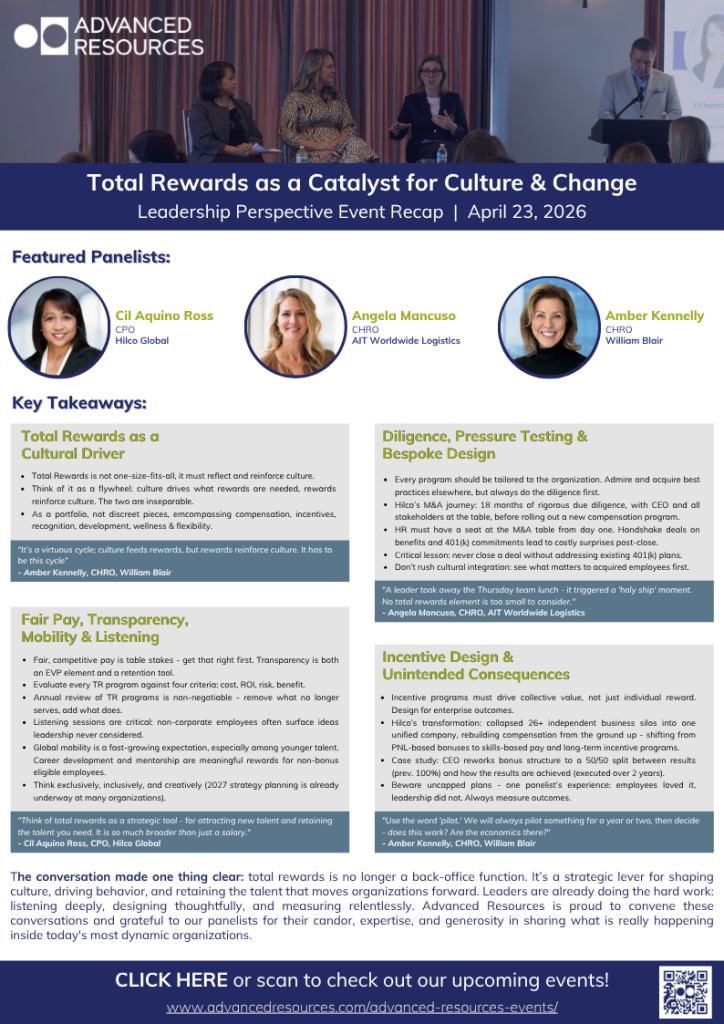
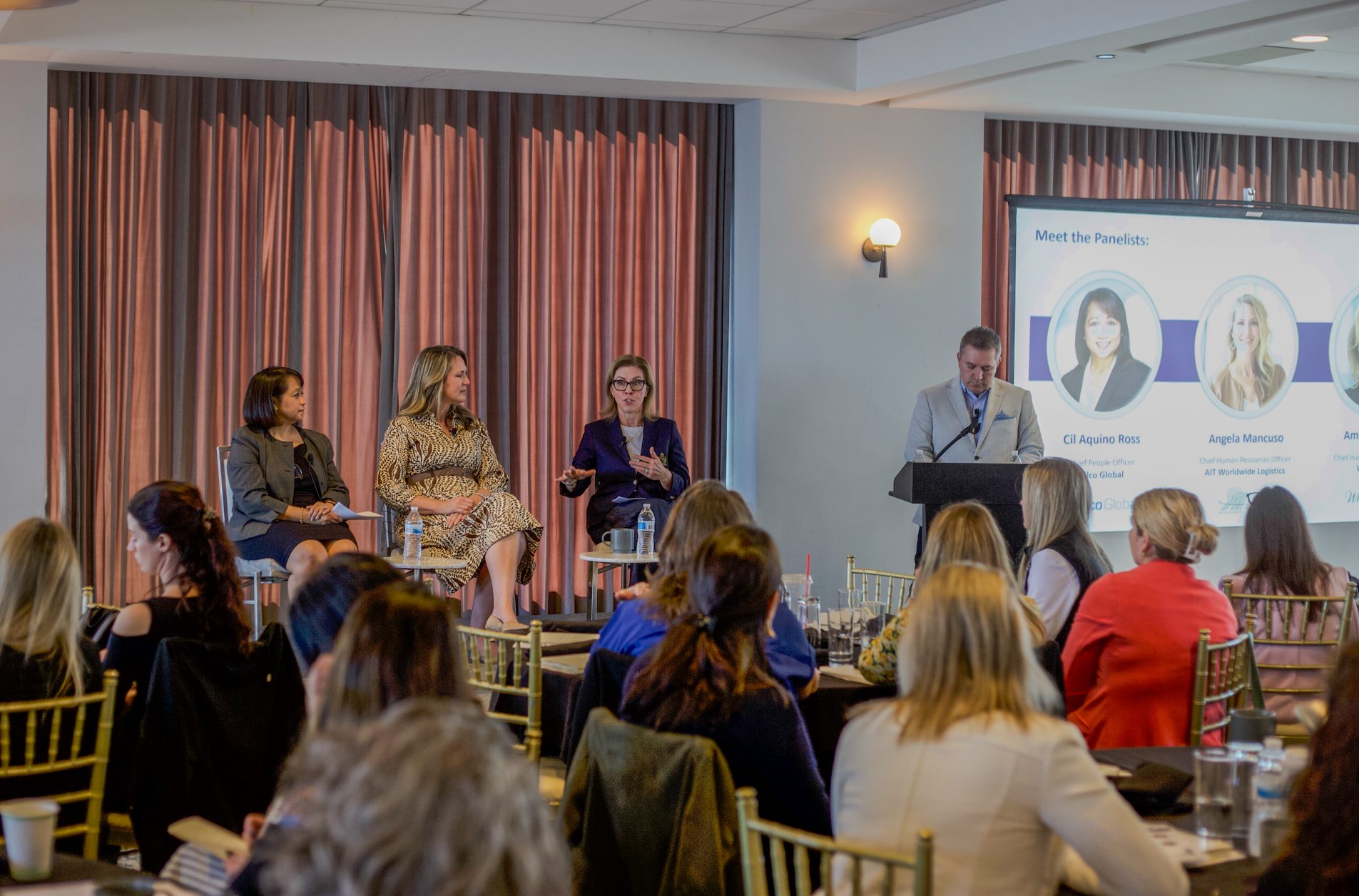
On April 23rd, Advanced Resources brought together three of the most thoughtful HR and people leaders in the business for an honest, high-impact conversation on one of the most dynamic disciplines in the field: total rewards. What unfolded was less a panel discussion and more a masterclass — candid, practical, and full of the kind of hard-won insight that doesn’t often make it out of the boardroom. Here’s what we took away.
Total Rewards Is a Cultural Driver — Not a Checkbox
The panel opened by challenging the most common misconception about total rewards: that it’s primarily about compensation. All three panelists pushed back on that framing immediately. Total rewards, they argued, is one of the most powerful cultural signals an organization can send — and it needs to be treated that way.
Amber Kennelly introduced what she called the “flywheel” — the idea that culture shapes what rewards are needed, and those rewards in turn reinforce culture. The two are inseparable. Strip out the strategic lens and you’re left with a transactional, one-size-fits-all program that serves no one particularly well.
“It’s a virtuous circle — culture feeds rewards, but rewards reinforce culture. It has to be this cycle.”
— Amber Kennelly, CHRO, William Blair
The panelists also reframed what total rewards actually encompasses: not just salary and bonuses, but incentives, recognition, development opportunities, wellness programming, and flexibility. Viewed as a portfolio rather than a list of line items, the picture becomes far richer — and far more strategically interesting.
Incentive Design Has Unintended Consequences — Plan for Them
One of the most gripping threads of the conversation came from Cil Aquino Ross, who walked the room through Hilco Global’s transformation from 26 independent business silos into one unified company. That kind of structural change doesn’t happen without a complete rethinking of how people are compensated — and the stakes are enormous when you get it wrong.
The panel was candid about a consistent tension in incentive design: balancing immediate cash compensation with long-term deferral programs. Both have their place, but the right mix depends entirely on what behavior the organization is trying to reinforce. One telling example: some CEOs have shifted to a 50/50 split between financial results and how those results are achieved — a meaningful shift in accountability that signals a new era of leadership expectations. Amber noted that a change of that magnitude is better executed over two years than implemented overnight.
“Use the word ‘pilot.’ We will always pilot something for a year or two, then decide — does this work? Are the economics there?”
— Amber Kennelly, CHRO, William Blair
The panel also addressed the very real risk of unintended consequences in plan design. One panelist shared a firsthand account of an uncapped compensation plan that produced outcomes leadership never anticipated — and didn’t want. The lesson: always define in advance what success looks like, and build in the mechanisms to course-correct. Pilot everything. Measure relentlessly. And never let a plan run on autopilot year after year.
Diligence Is the Differentiator — Especially in M&A
If there was a single theme that ran beneath every story shared on stage, it was this: the organizations that get total rewards right are the ones that do the work before they launch anything. That means research, stakeholder alignment, pressure-testing, and a willingness to slow down in order to get it right.
Cil described her team’s process before rolling out a new compensation program at Hilco: 18 months of due diligence, with the CEO and every key stakeholder at the table. That level of rigor isn’t bureaucracy — it’s what separates a successful implementation from a costly post-launch correction. The panel’s advice to fellow leaders was simple: admire and acquire best practices from other organizations, but always do your own diligence before adopting anything.
The M&A context brought some of the panel’s sharpest guidance. Cil was direct: HR must have a seat at the table from day one of any acquisition process. Handshake agreements on benefits and 401(k) commitments create enormous legal and financial exposure after the deal closes — and they happen more often than anyone would like to admit. The rule of thumb from the panel: never close a deal without fully understanding — and formally addressing — every existing benefit commitment.
“A leader took away the Thursday team lunch — it triggered a ‘holy ship’ moment. No total rewards element is too small to consider.”
— Angela Mancuso, CHRO, AIT Worldwide Logistics
Angela’s anecdote was a powerful reminder that the due diligence mindset doesn’t just apply to formal programs — it applies to everything, including the small, symbolic gestures that employees often care about most. Cultural integration requires patience. Understand what matters to acquired employees before you change anything.
Fair Pay, Transparency, and the Power of Listening
The final thread of the conversation turned to what employees actually want — and how organizations can build programs that truly reflect those needs. The panelists were unanimous: fair, competitive pay is table stakes. Get that right first. Everything else builds on that foundation.
Transparency emerged as both an EVP element and a retention tool. When employees understand how they’re compensated and why, trust goes up. When they don’t, the rumor mill fills the void — and rarely in the organization’s favor. The panel encouraged leaders to treat total rewards communication as a strategic function, not an afterthought.
Angela offered some of the session’s most memorable moments on the subject of listening. At AIT Worldwide Logistics, frontline employees — truck drivers, warehouse teams, non-corporate staff — consistently surface ideas that corporate leadership never would have generated on their own. Could routes be restructured so drivers could be home at night? Could a partner ride along on long-haul deliveries? These aren’t small asks — they’re windows into what people actually value at work. And they’re impossible to discover without creating the conditions for honest dialogue.
“Think of total rewards as a strategic tool — for attracting new talent and retaining the talent you need. It is so much broader than just a salary.”
— Cil Aquino Ross, Chief People Officer, Hilco Global
Amber closed with a practical framework every HR leader can apply immediately: evaluate every total rewards program against four criteria — cost, return on investment, risk, and benefit. Annual review of all programs, the panel agreed unanimously, is non-negotiable. What worked last year may not serve the organization this year. Sunset what no longer earns its place. Add what does.
And with 2027 strategy planning already underway at some organizations, Amber’s parting encouragement felt especially timely: it is never too early to be thinking about what’s next.
What made this conversation exceptional wasn’t just the caliber of insight — it was the honesty. These are leaders who have made the hard calls, learned from the costly mistakes, and built programs that genuinely move the needle for their organizations and their people.
Total rewards is no longer a back-office function. It is one of the most powerful strategic tools available to any people leader — for shaping culture, driving behavior, attracting top talent, and retaining the people who matter most.
Advanced Resources is proud to create space for these conversations, and deeply grateful to Cil, Angela, and Amber for their generosity, candor, and expertise.
We look forward to continuing the dialogue.
Download the full recap document here → Apr23 Leadership Perspective Recap – Total Rewards